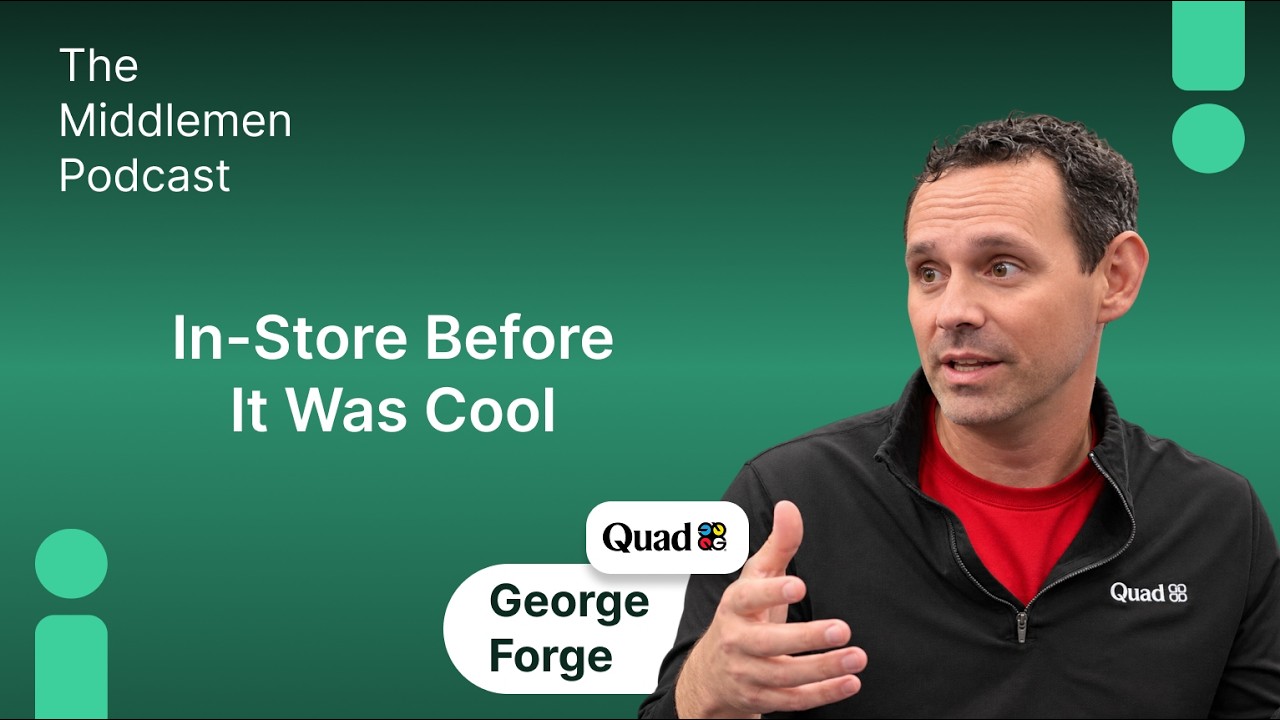
Most companies are just getting excited about in-store retail media. Quad has been in the store for decades. Recorded at Groceryshop 2026, this episode looks at how a company many still think of as a printer has turned its shopper marketing roots into one of the more complete in-store offerings on the show floor, and why it argues the store is the most valuable media asset a mid-sized grocer has.
George Forge of Quad joins Tom Limongello to explain the company's journey. Quad is 55 years old and calls itself one of the largest marketing services companies people don't know of. The Quadracci family ran a small grocery store during the Depression and started a printing operation in the back of it. Harry Quadracci founded Quad in Pewaukee, Wisconsin in 1971, and his son Joel, now CEO, steered it from the country's largest privately owned printer toward in-store media, display, packaging, creative and media. Quad is public but family controlled, and Forge describes the goal as being an anti-holding company: one connected, end-to-end solution. Quad works with grocers such as Publix, Kroger, Costco, Target, Meijer and Aldi, and on in-store campaigns for brands like Red Bull, AG1, Hanes and Energizer.
Consolidating acquisitions in print generated the free cash flow to invest in in-store, media and creative. On the media side, Quad acquired the performance agency founded by Jon Morris, whose work became Connex, a full-funnel planning product that pulls in data from online, at-home, retail media and at-shelf activations to answer where the next dollar should go. Quad also handles the largest segment of marketing mail in the US, and it has built a household-first data stack on top of that mail. Forge points out that it is cookieless and resilient, because people rarely move and file a change of address when they do.
That mail heritage shapes how Quad tests creative. A direct mail piece can cost 50 to 75 cents per piece, not per thousand, so the creative has to be right. Quad's Accelerated Marketing Insights practice now applies gaze patterns and heat maps to the store. For a large grocer's loyalty pop-up, testing showed shoppers' eyes wandering away from the call to action. Moving it, including placing it in the model's right hand since most Americans are right-handed, produced a double-digit increase in conversion. Quad runs this kind of testing on single tactics, in mock stores at innovation centers outside Milwaukee and in Greenville, South Carolina, with a third coming in Salt Lake City, and in pop-ups like the one at Groceryshop.
In-Store Connect by Quad is the company's effort to digitize the shelf. Its patented wedge vertical video banner gives a 180-degree viewing angle in the aisle, aimed at the split second when a shopper decides whether to turn down it. The average shopper goes down roughly six of ten aisles, so the goal is getting them down the seventh or eighth. Forge highlights complementary placements: wine near the open cheese and charcuterie case at the end of fresh, or beer in salty snacks. A test with a large beverage company showed a 30% lift in the promoted SKU and a 10% lift in the category.
Forge also has a contrarian take on screens. The instinct is to put a screen next to the product, but a shopper standing in front of the product does not need one. Endcaps change often with promotions and require merchant buy-in and joint business planning, so Quad uses two- and three-sided halo screens in fresh and frozen to avoid being locked to an exact shelf position. He prefers the word complementary over wrong for off-category placements, while noting that a mismatched message, like applesauce on a dog food endcap, simply confuses. In-store also takes C-suite engagement, since it means running electricity and adjusting shelving.
Looking ahead, Forge sees a small number of retail media networks capturing most of the dollars, leaving hundreds if not thousands of physical-first retailers behind. Their web traffic is generally weak, but their store traffic is not. If mid-tier and smaller grocers are not going to win online eyeballs, he argues, they need to compete for attention where they have it: in the store.


We're here to explain the most confusing topics in retail media, ad tech, mar tech and e-Commerce.